
Walt's Nine Old Men
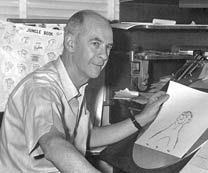
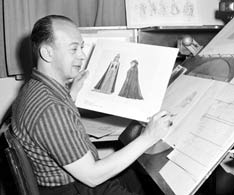
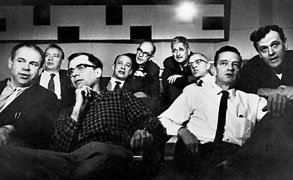
Walt's Nine Old Men were a core group of supervising animators who created Walt Disney Studios' most famous work - such as Snow White and the Seven Dwarfs and The Rescuers. Walt jokingly called them his "Nine Old Men" (even though most of them were in their 20s when they first started at the studio) - referring to U.S. President Franklin D. Roosevelt's nine Supreme Court judges. All nine of these talented gentlemen were named Disney Legends in 1989.
Leslie James Clark started as an inbetweener (an artist who creates the drawings that appear in-between the extremes of an action that are drawn by an animator) on the 1928 landmark short Steamboat Willie. But Clark's true debut as an animator came in 1929 on the first Silly Symphony, The Skeleton Dance (in particular a scene of a skeleton playing the ribs of a bony buddy like a xylophone). He entered animation at a pivotal time and took part in events that shaped not only Disney's future but the history of the art form itself. Clark made contributions to all of the early classics - such as Fantasia and Dumbo - and later became a directing animator for features like Alice in Wonderland and Peter Pan. After 48 years with Disney, Clark retired on September 30, 1975 - making him the longest continuously employed member of Walt Disney Productions. Sadly he passed away in September 1979 after suffering from cancer.
At Disney Reitherman became known as the "action man," animating such classic showdowns as the dinosaur battle in Fantasia, the Monstro chase scene in Pinocchio, and the clash between Prince Phillip and Maleficient the Dragon in Sleeping Beauty. He went on to direct such classic as The Jungle Book and The Rescuers and produce such features as The AristoCats and The Fox and the Hound. In 1963, Reitherman became the first animator in the history of the company to be given the directorial reins of an entire animated feature, beginning with The Sword in the Stone. He retired in 1981 but passed suddenly only 4 years later at age 75.
Larson started as an assistant animator on the shorts The Tortoise and the Hare and
Two-Gun Mickey. By 1940, he was an animation director and had designed Figaro the cat for Pinocchio. He also animated the horses and centaurs for the "Pastoral Symphony" sequence in Fantasia. Larson assisted Marc Davis in creating the title character of the 1950 Cinderella and animated Caterpillar for the 1951 Alice in Wonderland. But his
most famous sequence, is the flight to Neverland in the 1953 Peter Pan. After Walt's death in 1966, Larson was placed in charge of finding and training new talent (along with
animator Walt Stanchfield) - in addition to his character animating work (which ended as
a consultant for the 1986 The Great Mouse Detective). Many well-known animators went
through Larson's training program, including Brad Bird, Don Bluth, Tim Burton, Ron
Clements, Andreas Deja, Glen Keane, and John Lasseter. Larson retired in February
1986 after 52 years with Disney - making him the last of the 9 to retire. He passed away just two years later.
Like the others, Kimball too started as an inbetween artist on such shorts as Orphan's Benefit and The Goddess of Spring. But he quickly became active in all areas - an animator & designer of Jiminy Cricket for Pinnochio, a producer for the television
episodes Man in Space & Cosmic Capers, a writer & creator of the TV series The Mouse Factory, and directing animator of The Adventures of Ichabod and Mr. Toad. In 1948 he formed the Firehouse Five Plus Two, a Dixieland jazz band composed of fellow Disney employees. He also maintained a full-sized train and tracks at his home in California, and was a president of the Train Collectors Association. (Kimball is credited with helping and inspiring Walt Disney to install the Disneyland Railroad at Disneyland.) Kimball retired in 1972, but continued to do various projects on his own, and even returned to Disney to do some publicity tours. Three years after his 2002 passing, the Disneyland Railroad named their newly-acquired Engine №5 the "Ward Kimball" in his memory.
His earliest works include Mickey's Service Station and Mickey's Fire Brigade. Like the others,
Kahl made contributions to all the early classics such as Snow White and the Seven Dwarfs
(animating the forest animals) and Ferdinand the Bull (for which he also lent his voice to).
Often considered the finest draftsman and the best at drawing human figures of all the Disney
animators, Kahl later became directing animator for Lady and the Tramp and Sleeping Beauty.
His last work before retiring on April 30, 1976 - was as key animator for The Rescuers (released
in 1977). Kahl spent the rest of his life lecturing on animation before passing in April 1987.
He started out working on such shorts as Mickey's Circus and More Kittens. As a full-
fledged animator, Thomas contributed to features such as Fantasia, Dumbo, Bambi,
and Cinderella. He animated all 7 dwarfs in Snow White, the "I've Got No Strings"
number in Pinocchio, and the pond skating sequence in Bambi. Like Reitherman,
Thomas also enlisted in the U.S. Air Force in December 1942. He was discharged on
January 23, 1946 and rehired at Disney on April 1, 1946. Now a premiere character
animator, Thomas went on to serve as a directing animator for The Sword in the Stone
and The Jungle Book. Thomas was also a member of Kimball's Dixieland band Firehouse
Five Plus Two, playing the piano. After retiring on January 31, 1978 Thomas and his best
friend/fellow animator Ollie Johnston consulted on projects and wrote many books
together - including the acclaimed The Illusion of Life. Thomas even voiced a train
engineer in Brad Bird's 1999 film The Iron Giant, and a spectator in the 2004 The
Incredibles. Thomas passed 3 days after his 92nd birthday in September 2004.
He too began as an inbetweener on the shorts Mickey's Garden and Mickey's Rival. Johnston went on to contribute to all the early classics and eventually became directing animator for such features as Alice in Wonderland, Lady and the Tramp, and 101 Dalmatians. Like Kimball, Johnston's lifelong hobby was live steam trains. Starting in 1949, he built a 1" scale backyard railroad, with three 1/12th scale locomotives (later owned by his sons). This railroad was one of the inspirations for Walt Disney to build his own backyard railroad, which later inspired the building of the railroad in Disneyland. Ironically Johnston's wife, Marie, was also a Disney employee in the Ink and Paint Department. In the 1960s Ollie acquired and restored a full-size narrow-gauge Porter steam locomotive, which he named the "Marie E." Today it is owned by John Lasseter! Johnston retired on January 31, 1978 (along with Frank Thomas) and went on to write several books with Thomas (such as Too Funny For Words) and even lent his voice to the Disney/Pixar feature The Incredibles. Johnston was presented with a National Medal of Arts award by President George W. Bush and Laura Bush in 2005. The last living member of the Nine Old Men, he passed away in April 2008 in Washington.
His first assignment was as an assistant animator on Snow White and the Seven Dwarfs.
For the next several years, Lounsbery specialized in "Pluto" shorts, such as Pluto's Playmate, Pluto at the Zoo and Private Pluto. Lounsbery's later contributions included Honest John in Pinocchio, faithful Timothy the mouse in Dumbo and Tony the cook in Lady and the Tramp. During the war years, he worked on Victory Through Air Power, The Three Caballeros, and various propaganda shorts. He later served as directing animator on Winnie the Pooh and the Honey Tree and Winnie the Pooh and the Blustery Day, which won an Academy Award. Lounsbery underrated himself and underplayed his talent - and so in turn was vastly underrated as an animator-director by many in the business. He humbly continued to animate (specifically on The Rescuers) until his death on February 13, 1976 - sadly making Lounsbery the first of Walt's Nine Old Men to pass.
Like Lounsbery, Davis too began as an apprentice animator on Snow White. He then moved on to story sketch and character design on Bambi and Victory Through Air Power. But his greatest contributions would be the creation of Disney's most memorable animated women - Cruella De Vil in 101 Dalmatians, Maleficent in Sleeping Beauty and Tinker Bell in Peter Pan. He later transferred to Disney's design and development organization (today known as Walt Disney Imagineering). As one of Disney's original Imagineers, Davis contributed to such Disneyland attractions as the Enchanted Tiki Room, It's a Small World, Pirates of the Caribbean, the Haunted Mansion and The Jungle Cruise. (His wife Alice Davis created the original costuming for figures in the Pirates of the Caribbean and It's a Small World.) After 43 years with Disney, Davis retired in 1978, but continued to lend his expertise to the development of EPCOT and Tokyo Disneyland. He passed away in January 2000 - the same month the Marc Frasier Davis Scholarship Fund was formally established at the California Institute of the Arts.
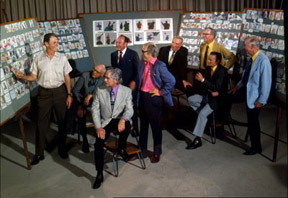
These highly-skilled men brought to Disney a wide variety of talents, ideas, and ambitions that resulted in animation that is still highly-regarded and loved today.
"There was competition, but it was an odd kind of competition. I’ve said before in a joking manner that Walt Disney’s greatest achievement was in getting us all to work together without killing one another!" -Marc Davis
WALT'S NINE OLD MEN
 | ||||




"I am in no sense of the word a great artist.
I have always had artists working for me whose skills were greater
than my own."
- Walt Disney

"When Frank and Ollie retired from production on the same Friday I was the next animator on Ollie’s desk the following Monday; the very desk he had used for decades to create so many indelible animated moments. I was properly awed as I sat down in Ollie’s chair, at his desk.
As I was checking it out and getting the feel of it I noticed the pencil sharpener was full of shavings. Instead of throwing them out I poured them into a glass jar, labeled it and set it atop the desk. Good luck shavings … a simple reminder of the hard work required to create magic. My own jar of real Disney dust. The last jar." -Brad Bird

"Of all the things I've done, the most vital is coordinating those who work with me and aiming their efforts at a certain goal." -Walt Disney
| ||||||

THIS DAY MADE
IN THE
USA

"People still think of me as a cartoonist, but the only thing I lift a pen or pencil for these days is to sign a
contract, a check, or an autograph." -Walt Disney
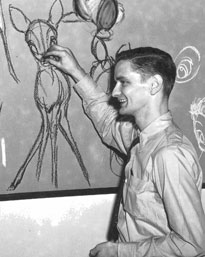
"John was not a pretentious man, but very much a teacher. Very kind and very sharing
with all of his information." -animator Don Bluth
| ||||
| ||||
| ||||
| ||||
| ||||
| ||||
| ||||
| ||||
| ||||
Les Clark from Utah (born 11/17/07) was the first of the nine to join the Disney Studios - on February 23, 1927 (just a few days after graduating from high school).
"Les quietly went ahead perfecting what he did best, constantly at art class working hard to improve and learn. There was much admiration for this quiet, thoughtful man, who came in with no art background yet through sheer determination and desire not only kept up, but helped advance the art with his refinements of many fundamentals." -Frank Thomas and Ollie Johnston
Career Highlights:
- Pinocchio
- Saludos Amigos
- The Three Caballeros
- Make Mine Music
- Cinderella
- Lady and the Tramp
- One Hundred and One Dalmatians
Wolfgang "Woolie" Reitherman (born 6/26/09) was hired by Disney Studios on May 21, 1933 - but began working June 1, 1933.
Born in Munich, Germany, Reitherman's family moved to America when he was very young. Originally wanting to become an engineer, his first Disney contributions included the shorts Funny Little Bunnies and The Wise Little Hen (Donald Duck's debut). During World War II, Reitherman left the Studio to enlist with the U.S. Air Force. He became an ace pilot (serving in Africa, China, and the South Pacific) and earned the distinguished Flying Cross medal. After the war, he happily returned to Disney.
Career Highlights:
- The Reluctant Dragon - Mickey and the Beanstalk
- The Adventures of Ichabod and Mr. Toad
- Winnie the Pooh and the Blustery Day
- The Jungle Book
- The Rescuers
"He didn't think he was a good artist, even though he was. He was always stuck with the chase stuff because most people hated to do that, but Woolie got a big kick out of doing fast, action, wild-out stuff and he did it well." -Ward Kimball
Eric Larson from Utah (born 9/3/05) began work at the Disney Studios on
June 1, 1933 - Woolie Reitherman's first day too.
"No one was more concerned with passing on the Disney legacy than Eric."
-animator Andreas Deja
Career Highlights:
- Who Killed Cock Robin?
- Snow White and the Seven Dwarfs
- Bambi
- So Dear to My Heart
- Mary Poppins
- Bedknobs and Broomsticks
"He was a brilliant animator and filmmaker with a distinctive style and humor
all his own." -Roy E. Disney
Career Highlights:
- Snow White and the Seven Dwarfs
- Mother Goose Goes Hollywood
- Fantasia
- The Reluctant Dragon
- Dumbo
- Cinderella
- Toot Whistle Plunk and Boom
- Mickey Mouse Disco
Milt Kahl (born 3/22/09) began working at the Disney Studios on June 25, 1934. Originally from San Francisco, he was inspired to seek Disney employment after seeing The Three Little Pigs.
"Milt Kahl's contribution to the art of Disney animation is immeasurable, and his work will continue to delight millions for years to come. If indeed, animators could be considered royalty, there's no doubt Milt Kahl would be king." -animator Floyd Norman
Career Highlights:
- Pinocchio
- Bambi
- Saludos Amigos
- Pecos Bill
-Song of the South
- Cinderella
- Peter Pan
- Winnie the Pooh and Tigger Too
Frank Thomas from Santa Monica, California, (born 9/5/12) joined the Disney Studios on September 24, 1934.
"Observe Everything. Communicate Well. Draw, Draw, Draw." -Frank Thomas
when asked to give advice to young animators
Career Highlights:
- Brave Little Tailor
- Melody Time
- Sleeping Beauty
- The AristoCats
- Robin Hood
- Winnie the Pooh and Tigger Too
- The Fox and the Hound
Ollie Johnston from Palo Alto, California (born 10/31/12) was hired by the Disney Studios on January 21, 1935. He and fellow animator Frank Thomas had met as art students at Stanford University.
"People know his work. They know his characters. They've seen him act without realizing it. He was one of the pillars, one of the key contributors to the golden age of Disney animation." -film historian Leonard Maltin
Career Highlights:
- Pinocchio
- Fantasia
- Bambi
- The Pelican and the Snipe
- Cinderella
- Sleeping Beauty
- The Many Adventures of Winnie the Pooh
- The Fox and the Hound
John Mitchell Lounsbery from Cincinnati, Ohio (born 3/9/11) was hired by
the Disney Studios on July 2, 1935. (While attending the Art Center School of Design in Los Angeles, an instructor sent him to interview with Walt Disney.)
Career Highlights:
- Song of the South
- Ben and Me
- Sleeping Beauty
- Goliath II
- The Sword in the Stone
- The Jungle Book
- The AristoCats
- Robin Hood
Marc Fraser Davis from Bakersfield, California (born 3/30/13) was the last of the 9 to join the Disney Studios on December 2, 1935.
"Milt Kahl, Frank Thomas, Ollie Johnston and myself did most of the animation on Bambi; a rather small group that helped, I think, to maintain its consistency."
-Marc Davis
Career Highlights:
- Song of the South
- Fun & Fancy Free
- The Adventures of Ichabod and Mr. Toad
- The Little House
- Melody
- Toot Whistle Plunk and Boom
"Frank Thomas, Ollie Johnston and Eric Larsen gave so freely to me that I feel not only a debt of gratitude but also a great responsibility to hand the baton on to young animators today." -animator & director Glen Keane

"We really don't have a story, with a beginning, an end, or a plot. It's more a series of experiences building up to a climax. I call them experience rides." -Marc Davis on Disneyland attractions
"It’s nice that people recognize our work. It was
a very strange business in that we were kept
anonymous throughout our entire careers. This
wasn’t too happy for artists who would have liked
that have signed their work and see their names
on the screen just like anyone else. To find that
we’re getting credit for what we did is a far cry
from the old days, when everybody thought Walt
Disney did all the drawing!" -Marc Davis
| ||||
"He had really crisp timing. He did one of the most complicated scenes I have ever seen - Jiminy Cricket putting on his coat because he's late and he's running. It's done like in a three-quarters perspective. He had a dancer's feel for animation." -director John Musker
This Day in Disney History - THE FIRST - THE ORIGINAL
Traveling in time since 1999!
The "Go the Distance" Guy
The Mighty Adventurer
The Renaissance Man
The King of Emotions
The Master Draftsman
The Mad Genius
The Beloved Mentor
The Bouncy, Trouncy, Flouncy One
The Steward of Sincerity
